


TRANSMISSION COOLERS & ENGINE OIL COOLERS
INTERNAL and EXTERNAL


The TOC works under fairly extreme conditions. Even in the best case scenario, the cooler is still operating in a radiator that gets over 200° itself. If the radiator is running properly, this shouldn't be a problem. But if radiators always worked the way they're supposed to, we wouldn't be in business. Let's face it, radiators go bad and cars overheat. Additionally, when a car's engine runs hot, so does its transmission. Burnt clutches are the number one cause of transmission failure in vehicles with automatics.
So, what could possibly go wrong? Pretty much everything. For one thing, what happens when your radiator starts building calcium deposits and the tubes that are plugged don't work? Your radiator will run hot and therefore the TOC inside of it won't be able to properly cool the transmission.
It doesn't always work out very well.
Transmission Coolers (TOCs)
Ever since the advent of automatic transmissions, radiators have been tasked with the job of keeping them cooled so that can work properly and last longer. Basically, the transmission fluid is pumped into a transmission fluid cooler, usually located in the outlet tank of the radiator (the coolest part of the cooling system). The coolant flows around the transmission cooler (often called a TOC, for Transmission Oil Cooler), removing excess heat before the fluid is pumped back to the transmission, where it is expected to cool the clutches of the transmission.
There are also times that the TOC simply breaks. This can be caused by engine vibrations (bad motor mount) or even an improperly installed line. In any case, the cooler will need to be replaced. At Acme, we carry many of the coolers that go bad most often. However, not all coolers are available and not all radiator cores are strong enough to handle the heat that's required to remove the tank. If you have a leaking TOC , bring it to us at Acme so that we can see what we need to do to help you!


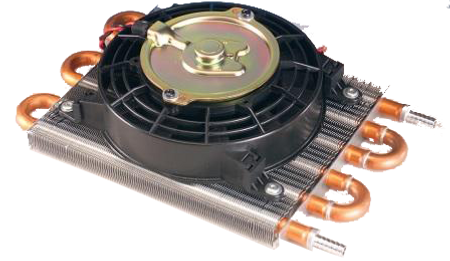
External Transmission Coolers (eTOCs)
Another potential problem is towing. Do you pull a trailer? If you're pulling your boat, RV, or landscaping trailer, your automatic transmission will run hotter and burn up a lot more quickly. Acme Radiator has a solution for this, as well! Bring your car, truck, van or SUV to us for an external transmission cooler. Working in conjunction with your internal TOC, the external TOC will keep your trans running much cooler!
The goal is to make sure that your cooling system doesn't run hot. If you see your temperature gauge operating at a higher temperature on average, bring it in and we'll gladly check it out before the problem gets a lot more expensive.
We can also help you with your medium- or heavy-duty truck! While most heavy trucks and equipment come with external transmission and engine coolers, they do go bad; they can get plugged or leak. We carry a full line of external coolers for both transmissions and engines. We also repair and clean them. So come down to see us at 49 Carleton Avenue in Islip Terrace and we'll take care of all your cooling issues! You're welcome to set an appointment, so please call us at 631.581.9199


Internal Engine Oil Coolers (EOCs)
In the 1970s, General Motors came out with their first line of diesel engines, which were primarily sold in Oldsmobiles and Cadillacs. And they ran hot! One of the remedies that GM came up with was to add an additional engine oil cooler (EOC) into the outlet tank of the radiator, across from the TOC. The EOCs in these cars were generally a bit larger than their TOC counterparts. Most had five “plates” for the oil to flow through and get cooled, whereas the TOCs usually had three plates or less. Most passenger cars that don't require heavy duty cooling at the factory come with cylindrical coolers.
Exhaust Gas Recirculation (EGR) coolers
Clogged Exhaust Gas Recirculation (EGR) coolers rob engines of their power. EGR coolers do exactly as the name implies. Fitted at the factory to all diesel powered trucks, as well as some gas powered rigs, EGR coolers are heat exchangers similar to marine applications. In order to prevent the buildup of dangerous Nitrous Oxide (NOx) fumes, the heated gases are redirected off the truck’s exhaust manifold to the cooler. The cooler is also fitted with passageways for engine coolant to flow between the gas passageways. The coolant brings down the temperature of the exhaust gases and protects the atmosphere.
However, EGR coolers get clogged over time. This will cause a significant loss of power in the engine and, if left untreated for enough time, will cause significant and expensive damage to the powerplant. These problems can be avoided by bringing your EGR cooler to Acme Radiator to be cleaned at regular intervals. The testing and cleaning is swift and inexpensive, well worth the peace of mind that you’ll have in knowing that your truck’s engine is more roadworthy!
There are multiple coolers used to protect engines and other components, and Acme is ready to help you with all of them. While they do differ from each other, all of these coolers are guided by the same principle: they use a fluid to dissipate heat, to keep everything running at the proper temperature. However, all of these coolers are susceptible to leaks, corrosion, and/or blockages. That’s why you need to call us at Acme Radiator to get a free estimate for repair or maintenance. We can be reached at 631-581-9199 weekdays from 8:00 am to 5:00 pm and Saturday mornings from 8:00 am to 11:00 am!


Maritime Cooling Solutions on Long Island

Acme Radiator is known as one of the few companies on Long Island to repair gas tanks on cars and trucks. Unfortunately, our insurance carrier won’t allow us to extend that offer to marine applications. However, we are happy to build new ones for you. Please bring your tank to us for a time and price estimate to build you a custom replacement tank.


Because we live on an island, boats and watercraft are a part of our business. As we specialize in the cleaning of coolers, such as radiators, heaters and EGR coolers, it’s natural that we clean and repair marine heat exchangers and tube bundles. Here are pictures of just a few that we’ve cleaned and repaired. As you can see, if the tubes are too clogged to be opened up using chemicals and power flushing, we can remove the end caps and run a rod through the tubes for a complete cleanout. If the tubing is too porous to be repaired, we can also manufacture a new bundle for you.
